
History
Where the garden obelisk comes from as an ornament
The garden obelisk isn't a French invention: its best-documented examples come from 18th-century English landscape gardens, not the jardin à la française.
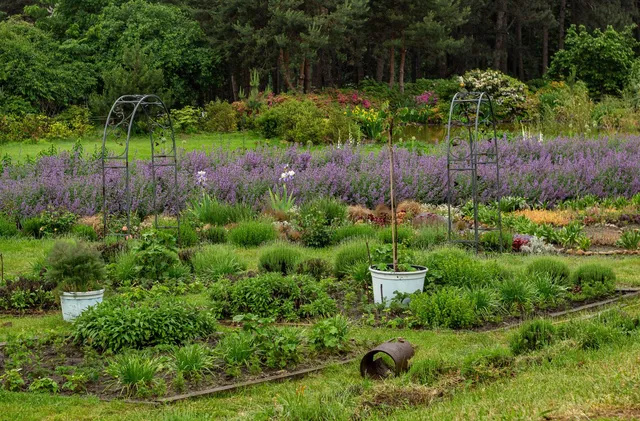
The word “obelisk” first brings Ancient Egypt to mind — but the garden obelisk, as an ornamental motif, is a more recent thing, and its documented history points mainly to England, not to the French formal garden as one might assume.
18th-century English landscape gardens
Several major 18th-century English landscape gardens feature an obelisk as part of their composition. At Stowe (Buckinghamshire), architect John Vanbrugh designed an obelisk-fountain as early as 1719, standing at the centre of an octagonal lake laid out by Charles Bridgeman. At Chiswick House, Lord Burlington erected an obelisk in 1732, incorporating a classical sculpture acquired two decades earlier. Other documented examples exist at Umberslade (Warwickshire, around 1748) and Hall Barn (Buckinghamshire, early 18th century, likely by architect Colen Campbell).
What about the jardin à la française?
The French formal garden, brought to its peak by André Le Nôtre at Vaux-le-Vicomte and then Versailles in the 17th century, is mainly associated with geometric parterres, basins and clipped perspectives — not, based on the sources consulted, with the obelisk as a standalone vertical ornament. While this motif is part of today’s popular image of the classical French garden, its documented lineage points more toward 18th-century England.
From monumental stone to garden wrought iron
The wrought-iron garden obelisk, transportable and modest in size, is a much more recent and much humbler object than these 18th-century architectural pieces — a plant support or a focal point for a private garden, not a monument. The compositional principle, though, stays close: a clean vertical form, used alone as a focal point or in pairs to frame a passage — see our large-format decorative obelisk page.
Frequently asked questions
Does the garden obelisk come from Ancient Egypt?
The name and general shape draw on it, but the garden obelisk as an ornamental motif is a European garden object, documented mainly in 18th-century England — not a direct import from Egypt.
Did the French formal garden use obelisks?
The sources consulted don’t confirm the use of the obelisk as a free-standing ornament in the classical French formal garden — at Versailles, the obelisk shape appears on fountains, not as a piece standing on the ground.
Do today’s garden obelisks look like 18th-century ones?
No — the historical examples are fixed, often large stone monuments. Today’s wrought-iron garden obelisks are modest pieces, designed for a private garden.
Read next