
Composition
Where to place an obelisk in your garden
Single focal point, symmetrical pair, rhythmic row: the composition principles for placing a garden obelisk well, singly or in numbers.
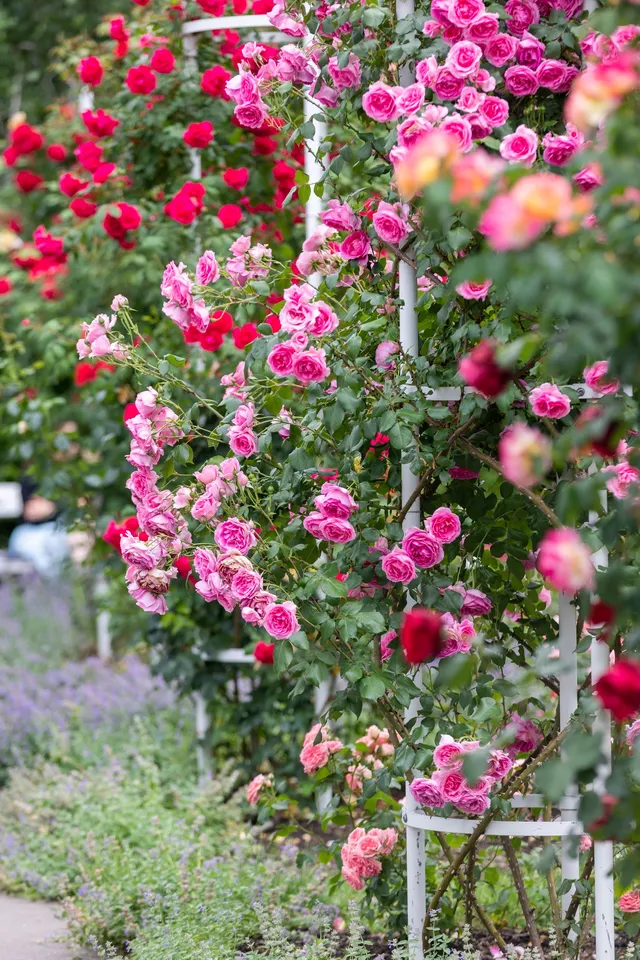
A well-placed obelisk structures a garden; badly placed, it either gets lost or, conversely, draws the eye for the wrong reasons. A few composition principles, drawn from current garden design practice, help decide.
The focal point: only one at a time
A focal point is anything that catches the eye first — a statue, a fountain, a remarkable plant, or an obelisk. The most commonly cited rule: only one focal point per garden area. Several elements competing for attention cancel each other out rather than reinforcing one another. A single obelisk therefore works better at the end of a vista or at the centre of a bed than surrounded by other decorative pieces of similar visual weight.
Height matters: don’t exceed the garden’s boundary
Garden Gate Magazine warns against a focal point that’s too tall: if it rises above the garden’s visual boundary (a fence, a hedge), the eye is drawn beyond the garden itself — the opposite of the intended effect. A large-format obelisk therefore does well to stay below the surrounding fence or hedge line, unless deliberately drawing the eye toward the horizon is the goal.
In pairs: symmetry that frames
Placed on either side of a path, gate or entrance, two matching obelisks create an instantly readable symmetry — the most classical use of the motif. The principle of symmetry (mirrored elements on either side of a central axis) is historically associated with formal gardens, as opposed to asymmetrical balance, more informal, where elements don’t correspond to each other one-to-one.
In a row: the rhythm of a path
Beyond two pieces, a regular row along a path punctuates the view at intervals rather than creating a single stopping point. This extends the symmetry and rhythm principles of garden design, even though we didn’t find a source specifically naming the obelisk in this role — the general principle of rhythmic repetition of vertical elements along a path is, however, well established in garden design practice.
Frequently asked questions
Can a garden have more than one focal point?
Yes, but not within the same visual area at the same time — one focal point per zone or per vista, to avoid elements cancelling each other out.
Can a large-format obelisk be too tall?
Yes, if it rises above the garden’s visual boundary (fence, hedge) — the eye is then drawn beyond the garden rather than staying within it, unless that outward pull is the intended effect.
Do obelisks always need to be placed in pairs?
No — singly for a focal point, in pairs to frame a passage with symmetry, in a row to punctuate a path: three different uses depending on the effect you want.
Read next